Opening the front door to Edge's talent marketplace
ROLE
Senior Product Designer
Duration
2 month
Team
1 Product Manager
3 Engineers
3 Engineers
Status
Shipped - Beta
The project
Edge built its business on managed staffing, hand-matching vetted talent from Pakistan and Peru with US healthcare and insurance clients. In late 2025, the business made a strategic bet: replace a slow, manual matching operation with a two-sided talent marketplace, where clients browse the full talent pool and shortlist people directly.
That bet only works if talent can get in. I designed the talent application, the front door of the marketplace: sign-up and eligibility, the profile builder, video introductions, and the dashboard where talent sees the marketplace respond to them.
The old application lost nearly two-thirds of its visitors before they even began applying. The new one carries around 70% of them all the way to a completed profile.
That bet only works if talent can get in. I designed the talent application, the front door of the marketplace: sign-up and eligibility, the profile builder, video introductions, and the dashboard where talent sees the marketplace respond to them.
The old application lost nearly two-thirds of its visitors before they even began applying. The new one carries around 70% of them all the way to a completed profile.
Outcome
In the first 4 months since launch (as of July 1, 2026)
13K+
Talent sign-ups
~70%
of visitors complete their full profile
400+
Vetted profiles live on the marketplace
Baseline and post-launch figures from LogRocket and Edge's internal records.
The operation behind the old model
Every hire at Edge moved through the same manual pipeline. When a client asked for a role, the team dug through spreadsheets to find matches, fixed up each resume by hand or wrote one from scratch, emailed PDFs to the client's inbox, and scheduled interviews for whoever made the shortlist.
It worked, but it didn't scale. Every placement consumed hours of manual work across multiple people, and growth was capped by how many people Edge could throw at the process. Clients couldn't see the talent pool themselves, so every additional hire meant starting the whole pipeline over. The marketplace was the answer to all of this, but it came with a hard requirement: every profile a client would ever browse had to be created, structured, and vetted first. The talent application is where all of that happens.
It worked, but it didn't scale. Every placement consumed hours of manual work across multiple people, and growth was capped by how many people Edge could throw at the process. Clients couldn't see the talent pool themselves, so every additional hire meant starting the whole pipeline over. The marketplace was the answer to all of this, but it came with a hard requirement: every profile a client would ever browse had to be created, structured, and vetted first. The talent application is where all of that happens.
The old application was built for a different era
The old application was built for the managed staffing model, and it showed. Three problems made it unfit for a marketplace.
Lost before starting
Three pages stood between landing and Step 1: pick a city, pick an industry, land on an industry page. Only 34.6% of visitors ever made it through.
Rejection meant starting over
Applications were tied to single job openings. Talent applied, interviewed, and if it didn't work out, went back to the beginning. Apply, get rejected, reapply.
Captured too little
The application couldn't collect the structured data a real profile needs. Every resume Edge rebuilt by hand was compensation for what the application failed to capture.
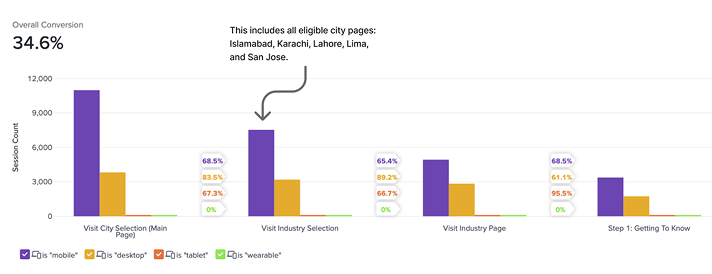
The funnel, January 2025. Over 14,000 visitors landed on the main page that month. Each page before Step 1 shed roughly a third of them.
A marketplace needs profiles that persist, data that's structured, and an entry flow people actually finish. The old application offered none of the three.
The decision that shaped everything: Profile-First, not a job board
The marketplace decision answered the business question but opened a design one: what does talent actually build when they sign up? The path of least resistance was a cleaner, faster application flow, the same shape as before with the friction sanded off.
Research pointed somewhere else entirely. Interviews with talent about the old application kept surfacing the same fatigue: they didn't want a better way to apply repeatedly, they wanted to stop applying. And clients didn't need applications at all. They needed rich, structured, always-current profiles to browse.
So the application was designed around one principle:
Research pointed somewhere else entirely. Interviews with talent about the old application kept surfacing the same fatigue: they didn't want a better way to apply repeatedly, they wanted to stop applying. And clients didn't need applications at all. They needed rich, structured, always-current profiles to browse.
So the application was designed around one principle:
Build your profile once, get vetted once, and stay in the marketplace. No reapplying, ever.
That single decision set the shape of everything downstream. The entry flow could ask for more upfront, because talent was building an asset, not filling a form for one job. Rejection stopped being a dead end, because a profile persists whether or not any single interview works out. And every field the application collected could be structured, because it was feeding a browsable profile instead of a PDF.
Designing the Talent Application
The profile-first principle set the shape. What follows is how it became a working product, told through the two decisions that mattered most.
Decision 1: Ask little, answer fast
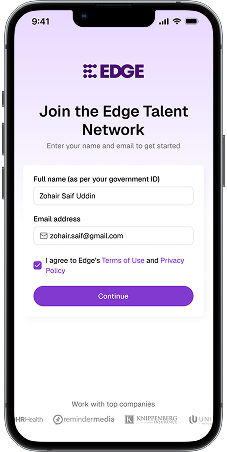
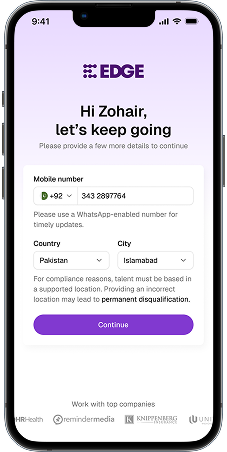
Two screens stand between a visitor and their eligibility answer. The first establishes who they are, the second settles whether Edge can work with them, and the whole exchange is designed to be finished inside the first minute.
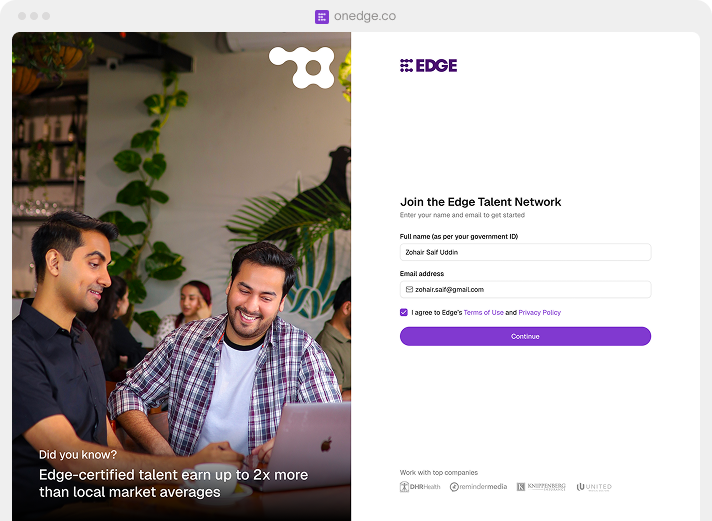
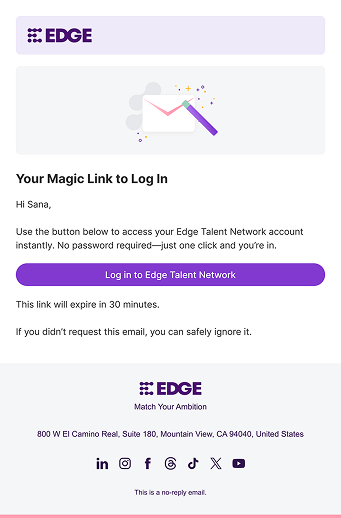
The entry point does three jobs: a name as it appears on a government ID, an email that gets verified before anything else happens, and consent to the terms. Passwordless by design, login runs on magic links, so the verified email is the only credential that ever exists.
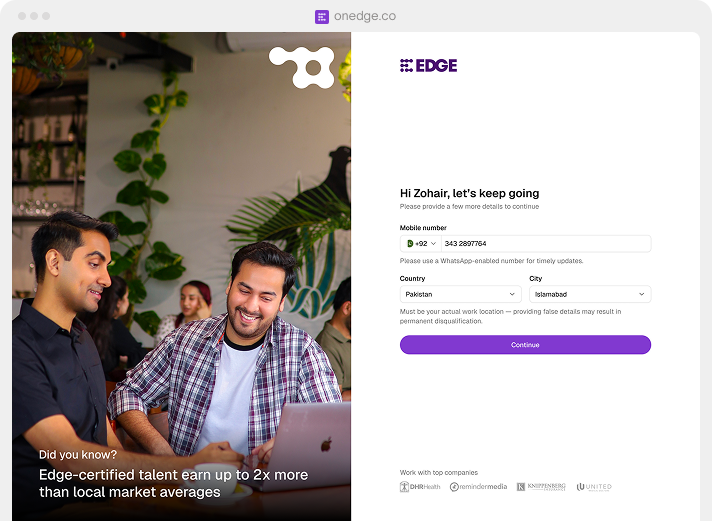
After email verification, the application asks for a phone number and location, and this screen fixes the old app's biggest leak. The old application also checked location early, but hiring cities were browsable upfront, so people shopped locations until one worked and applied from wherever Edge was hiring, whether they lived there or not. Here the direction flips: talent declares where they actually live before any hiring information is revealed, and the location locks for 30 days once set. Shopping the answer now costs a month per guess.
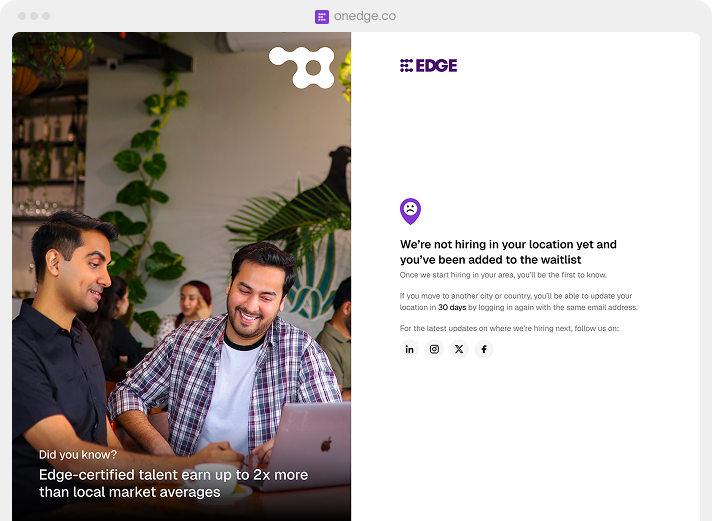
Ineligible doesn't mean rejected. Talent outside Edge's hiring locations lands on a waitlist, gets a confirmation email, and keeps a path back in: after the 30-day lock, they can update where they are. When Edge expands, they're the first to know.
Decision 2: One profile, built in the open
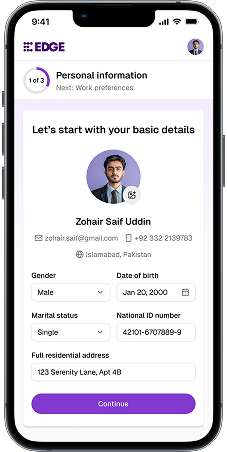
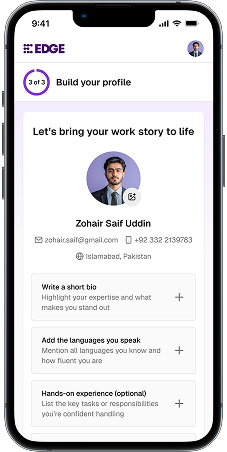
The old application collected too little, in the wrong shape, through a flow nobody could see the end of. The profile builder answers all three at once: the journey is shown before the first field, every input is structured at the source, and the profile assembles on screen as talent builds it, what they're making is never hidden behind a form.
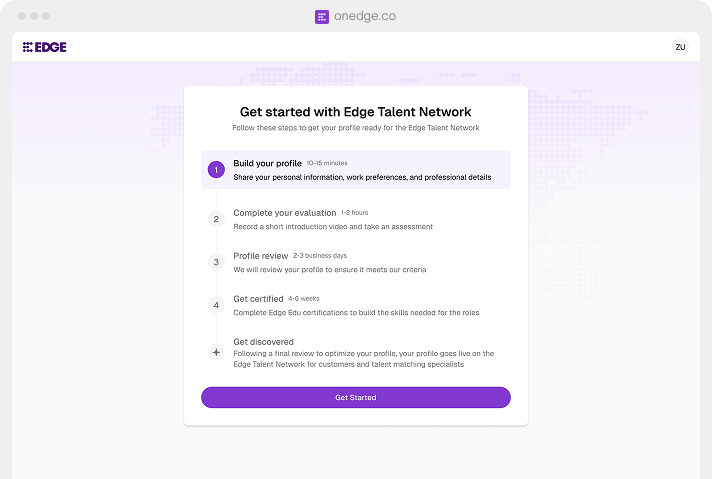
The contract screen. Before any field appears, talent sees the entire journey and what each step costs.
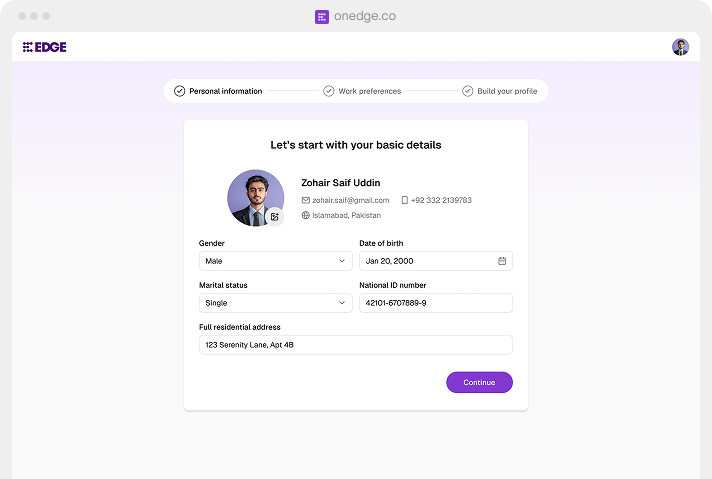
Inside the build, a three-step stepper stays visible the whole way: Personal information, Work preferences, Build your profile. Progress saves between sessions, close the tab, log back in tomorrow, continue where you stopped.
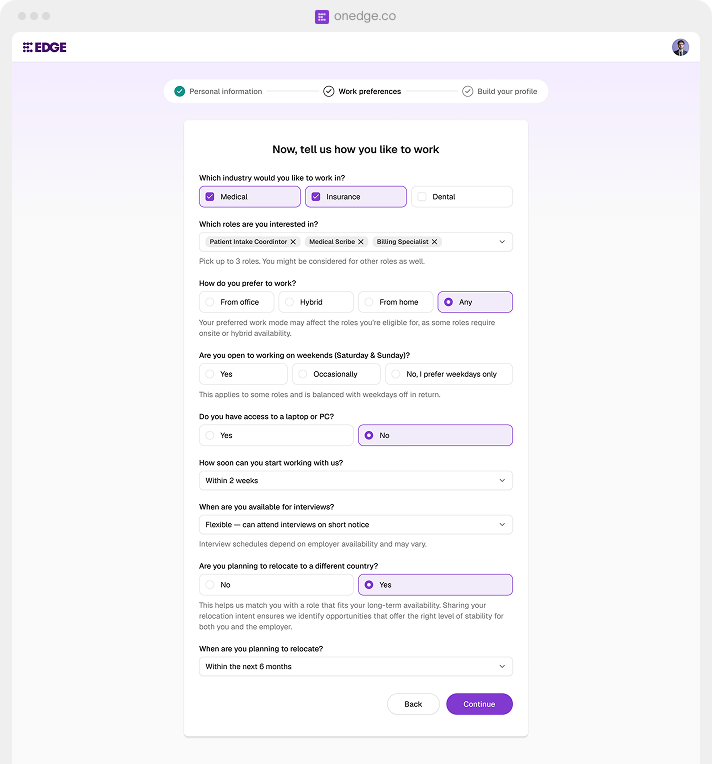
Notice period, weekend availability, laptop ownership, relocation intent. The questions Edge staff used to chase over calls and messages for every single placement, captured once, as structured data, and kept current.
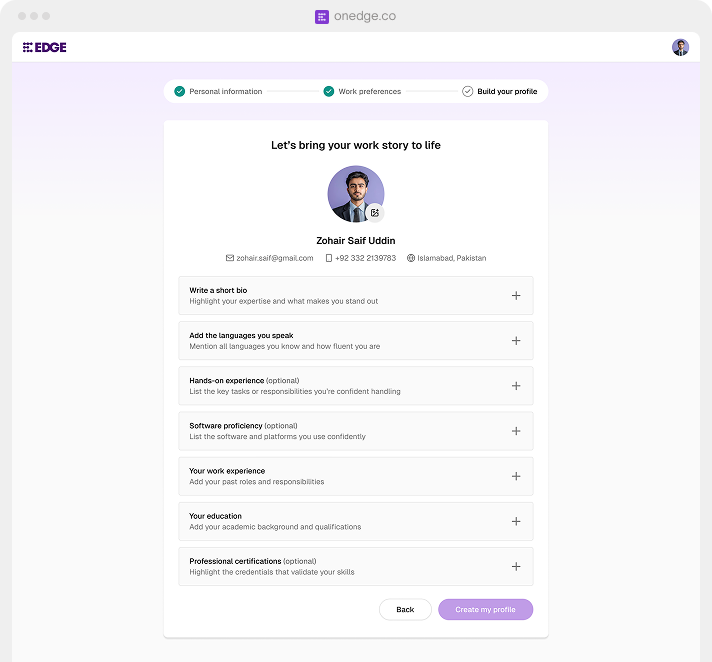
The build screen starts as an outline: bio, languages, hands-on experience, software, work experience, education, certifications, each section a tap away, fillable in any order, one focused piece at a time.
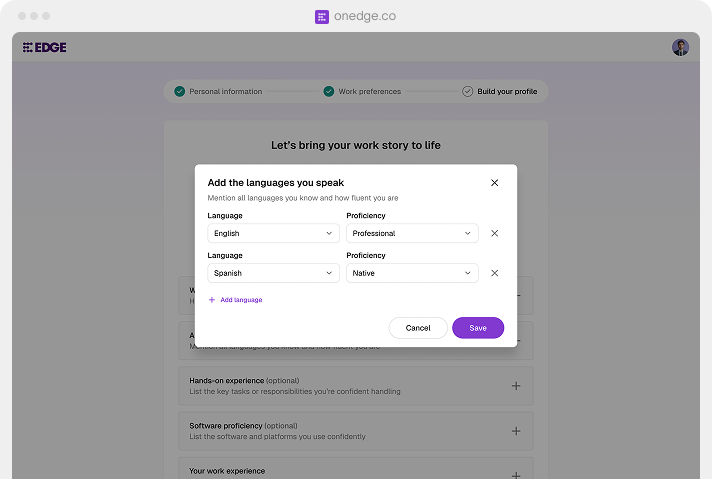
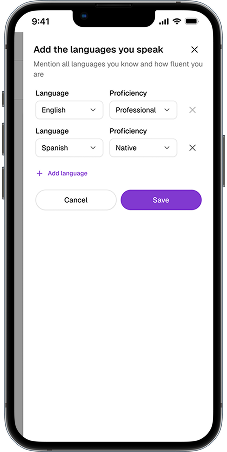
Every section opens as a modal that asks for one thing and asks for it structured: languages with proficiency levels, skills as selections, experience as task chips. No free-text walls a client would have to decode later.
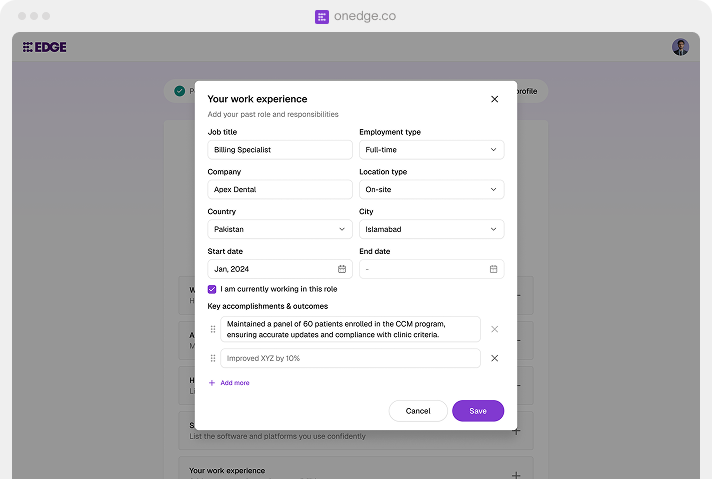
The heaviest section gets the most structure: role, company, dates, accomplishment lines, as repeatable entries. The exact information Edge staff used to extract from PDFs and rewrite by hand, now captured client-readable at the source.
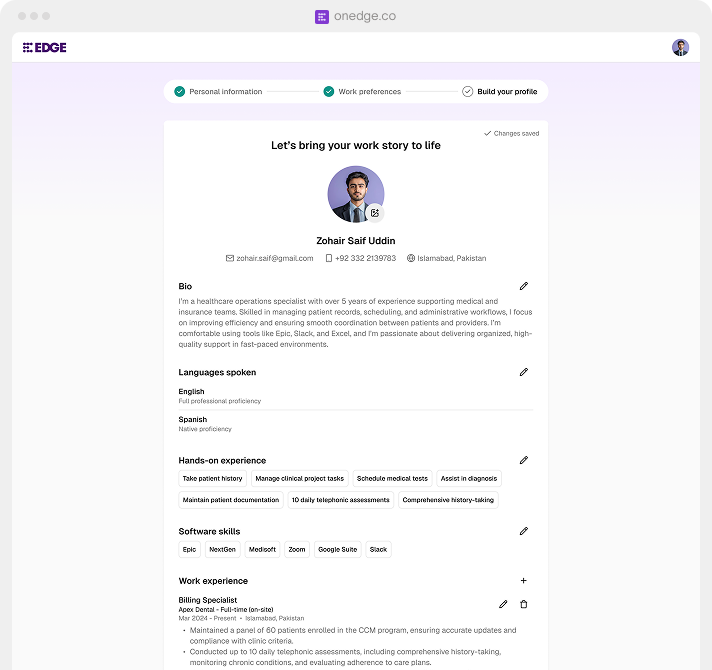
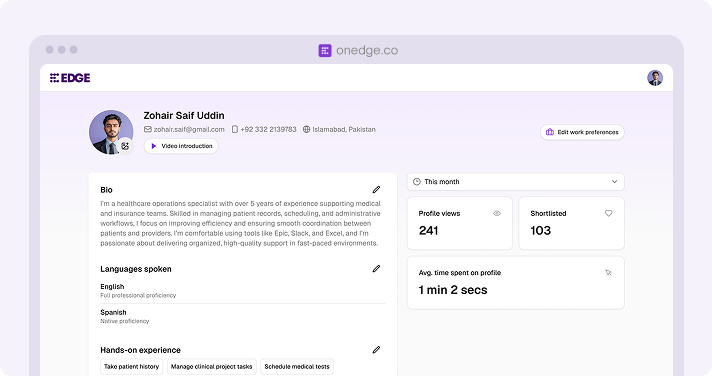
As sections complete, the page assembles into the profile a client will eventually browse. The form and the profile are the same surface, talent isn't feeding a system that generates a profile somewhere else, they're building the artifact itself, in the open.
Earning a place on the network
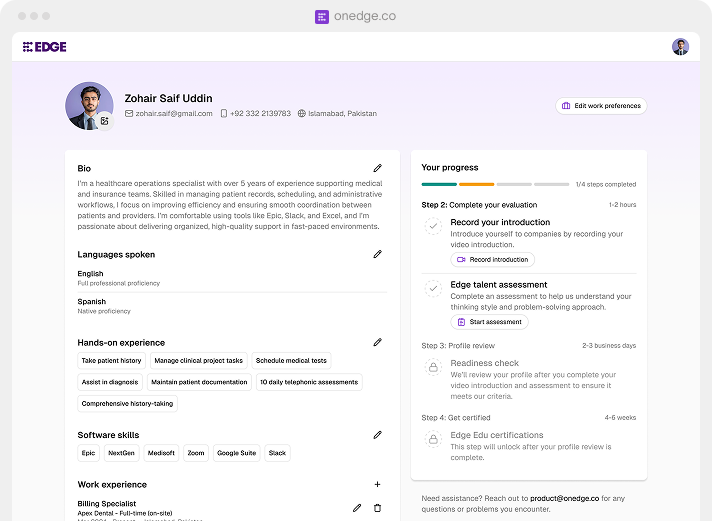
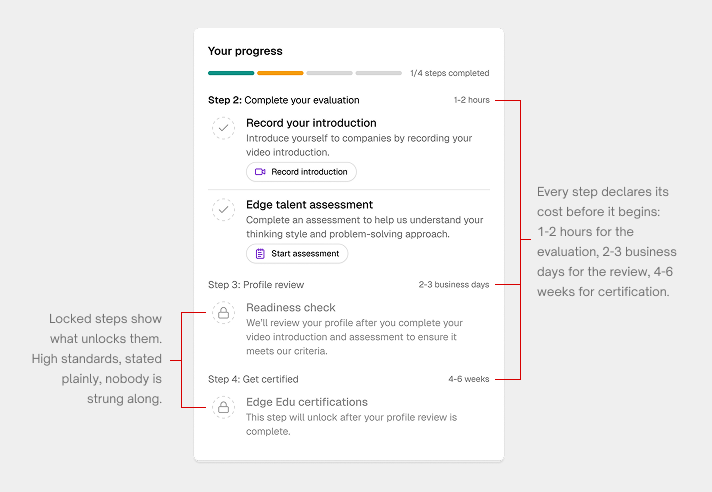
The Talent Network is built on a promise to clients: every profile they open has already been tested, reviewed, and certified. So between a completed profile and the marketplace stand three deliberate steps: an evaluation, Edge's readiness check, and certification. The design challenge wasn't removing this rigor. It was making a demanding, weeks-long process feel fair, transparent, and worth finishing, so the right people stay in it.
Costs stated upfront
The video introduction, engineered for nerves
The evaluation opens with the most anxiety-inducing thing the journey asks: speak to a camera, for a professional audience, often in a second language. The flow is engineered to lower the stakes.
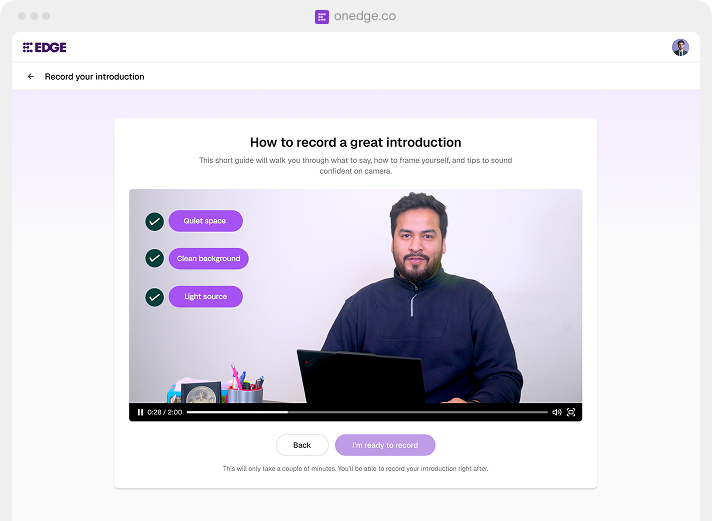
Before recording, talent watches a short example of what good looks like: quiet space, clean background, light source. Nobody is asked to perform without seeing the standard first.
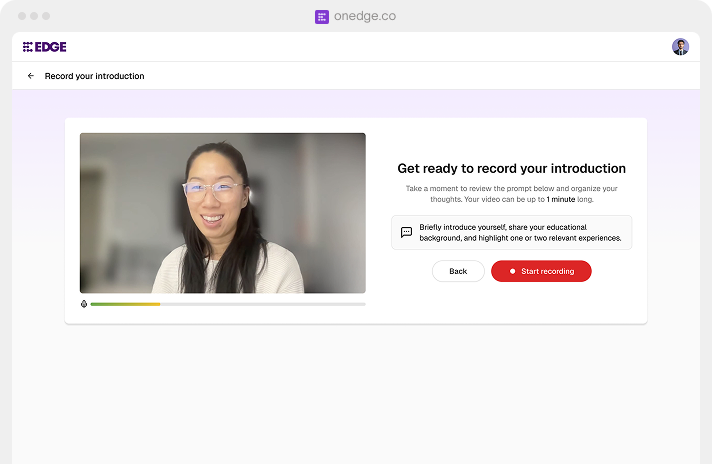
The prompt appears before recording starts, introduce yourself, your background, one or two experiences, with a one-minute cap. Knowing the question in advance turns a test into a task.
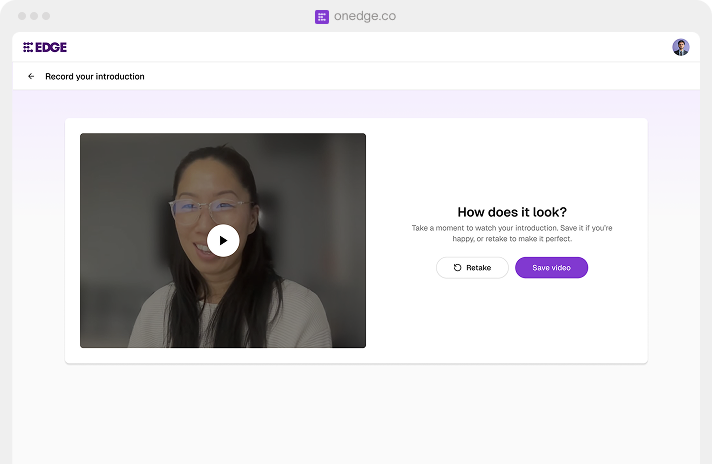
After recording, talent previews their video and can retake it as many times as they want before saving. Unlimited retakes was the deciding call: it converts a performance into a draft. The flow also handles camera permissions, dropped recordings, and failed uploads, each with a recovery path.
Feedback, not verdicts
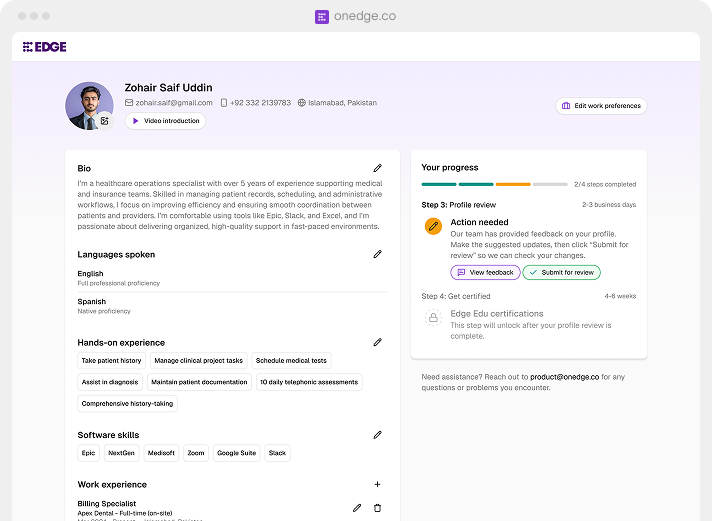
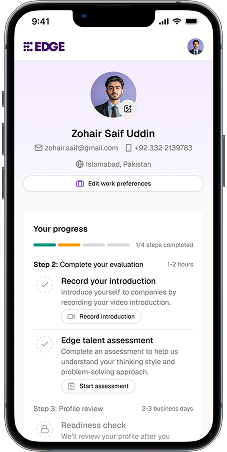
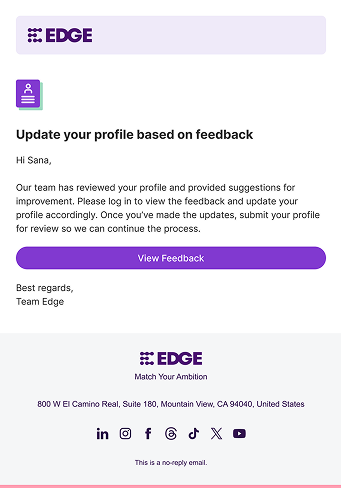
The readiness check is where Edge's team reviews the profile and responds. When something falls short, talent gets specific feedback in the panel itself and a resubmit path. The bar stays high; the door stays open.
The long step, kept anchored
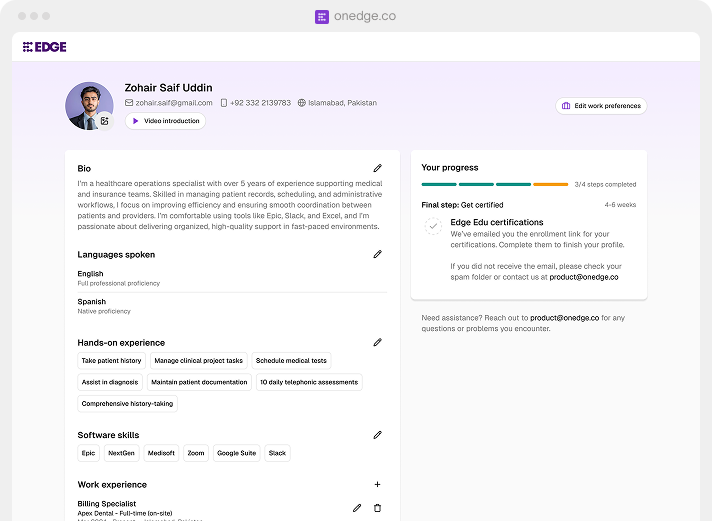
Certification runs 4-6 weeks on an external platform, the longest and final step. The panel keeps it anchored to the journey, so even the quietest stretch of the process never loses the thread. Completing it means something: everyone on the network cleared the same bar.
Becoming part of the network: The Dashboard
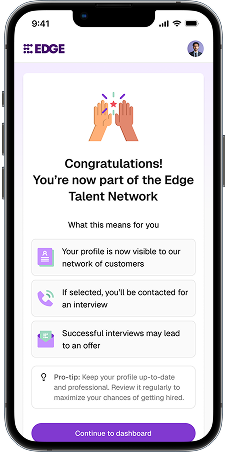
Certification complete, and the same screen quietly changes meaning. The journey tracker's work is done; what's left is a network member's home.
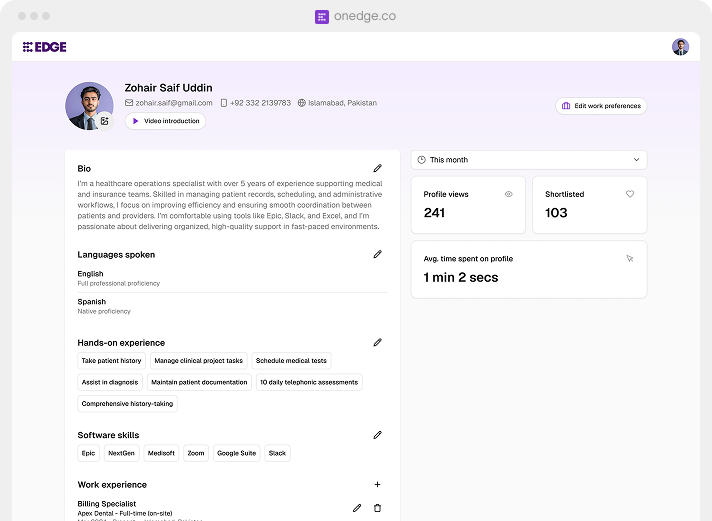
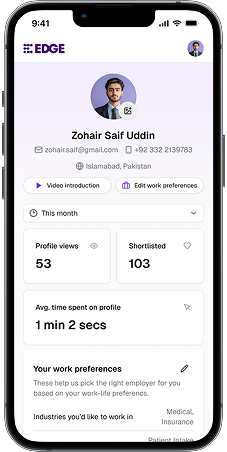
Under the old model, a resume disappeared into an email thread and talent heard nothing until an interview happened or didn't. Now they watch the marketplace respond: how many clients viewed their profile, how many shortlisted them, and how long clients actually spent reading, tracked month by month. Demand, made visible to the person being browsed. When a shortlist turns into interview interest, Edge's marketplace team coordinates directly between the client and the talent.
Tested with the people it was built for
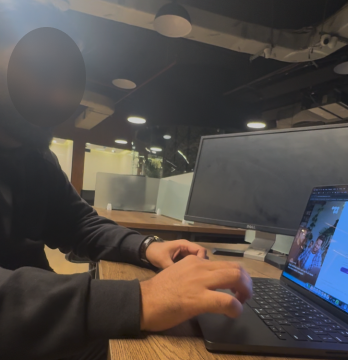
Before launch, we ran moderated sessions with talent inside Edge's HQ, walking them through the application while we watched and recorded. The sessions sharpened flows across the application before release and confirmed the calls that mattered most, talent moved through the entry gate and profile builder without needing help.

Built for both screens
Talent reaches the application from wherever they are, so every flow ships in two layouts. Same steps, same states, same weight given to both. A selection of the mobile counterparts:
Keeping talent engaged between stages
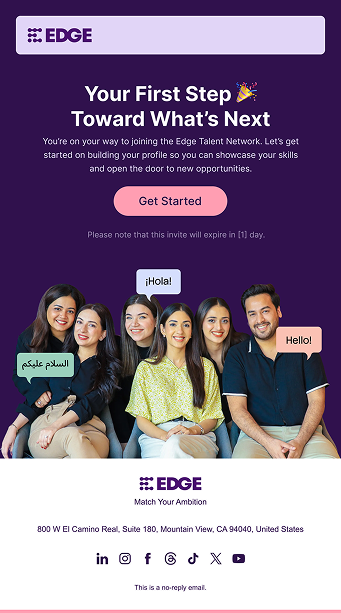
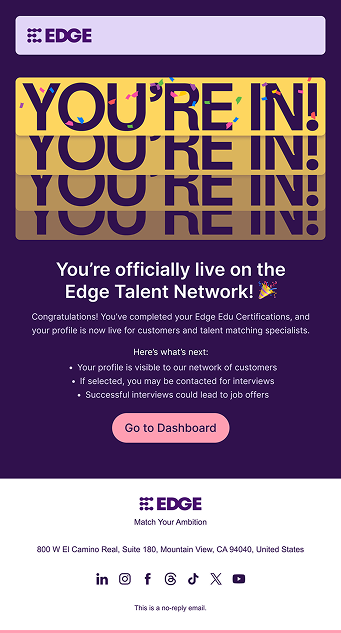
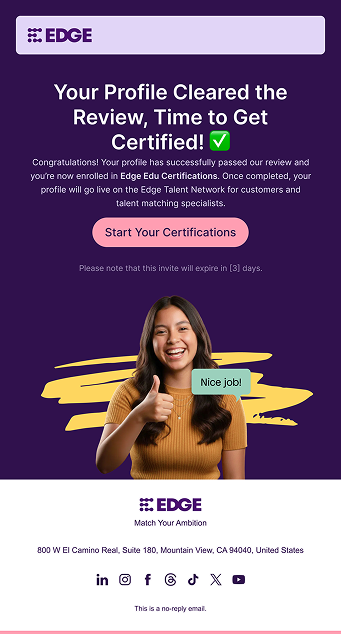
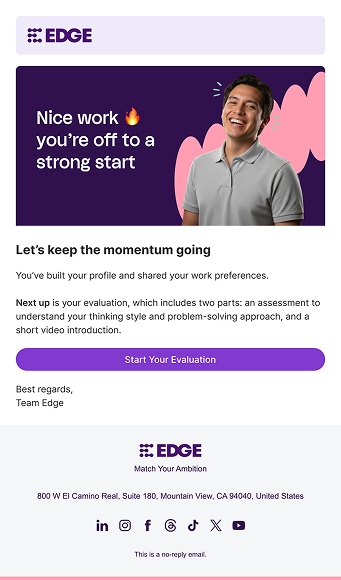
A journey with built-in waiting has built-in silence: days in review, weeks in certification, stretches where nothing is asked of the talent at all. Silence is where people assume the worst and quietly leave. The lifecycle emails are the design answer, covering every stage transition and every failure state, written for a talent base that skews Gen-Z and millennial. Two rules run through the system: milestones go loud and celebratory, hard news goes plain and calm, and every email states what happens next and when.
Reflections
What I took away
Design the waiting, not just the screens
The talent journey runs weeks, and most of it happens off the platform or in silence. The progress panel and lifecycle emails did as much work as any flow. A process people can see is a process they finish.
Rigor and drop-off aren't a trade-off
The pipeline is deliberately demanding, evaluation, review, certification, yet around 70% of visitors who land complete their profile. Stating costs upfront and keeping every step transparent let Edge keep the bar high without losing the people it wanted.
Assume the system will be gamed, from day one
Hiring cities used to be browsable, so people shopped locations until one worked. The new flow asks first and answers second, with a 30-day location lock, designed before launch because the old model had already shown the behavior.